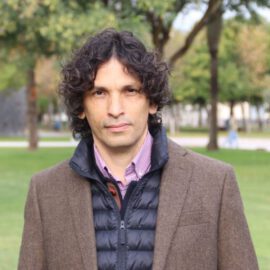
Portrait of Juan Carlos Castro-Palacio

Juan Carlos Castro-Palacio

Materials Science & Molecular Simulations

Academic research profileQueen Mary University of London · UK

Postdoctoral Researcher · Queen Mary University of London

Dr. Juan Carlos Castro-Palacio

School of Engineering and Materials Science
Queen Mary University of London, UK

Physicist and materials scientist specialising in computational modelling, molecular simulation, and machine learning. I develop atomistic and data-driven methods to understand and predict molecular interactions, materials behaviour, and interfacial processes, combining molecular dynamics, machine-learned interatomic potentials, statistical mechanics, optimisation, and scientific computing to accelerate materials modelling and discovery.

Publications
106
Active since
2003
PhD students supervised
8

Related institutions

  • Institute of Nuclear Sciences and Technology, HavanaBSc & PhD
  • Weizmann Institute of Science, Israel2005
  • University of Tokyo, Japan2007–2009
  • University of Basel, Switzerland2013–2015
  • Imperial College London, UK2015–2018
  • Technical University of Madrid, Spain2018–2019, 2020–2021
  • Universitat Politècnica de València, Spain2021–2026
  • Queen Mary University of London, UK2026–present

Latest

Research stays

  • Academic visit to Florida International University.
  • Research stay with Prof. Ricardo Grau-Crespo’s group at Queen Mary University of London.
  • Research stay with Prof. Georg Held’s group at the Diamond Light Source synchrotron (UK), in close collaboration with Prof. Ricardo Grau-Crespo’s group at the University of Reading.

Articles

Conferences

  • Oral contribution at COST Innovators Grant IG18234, “Machine learning from computational materials science data for modelling nanocrystal catalysts”, 16–18 July, Budapest, Hungary.
  • Oral contribution at the Summer Meeting of the American Association of Physics Teachers (AAPT), 6–11 July, Boston, MA.

Member of the American Association of Physics Teachers (AAPT) since 2024.

Awards

  • Award for Innovative Activity in Scientific Communication and Dissemination, Universitat Politècnica de València (as a member of the awarded team).
  • Prize for the Best Physics Teaching Article published in the journal of the Royal Spanish Physical Society. Jury decision (p. 5)

Press

“You cannot take home a whole physics laboratory, but most people have a smartphone.”
Interview with Physics magazine (American Physical Society) on smartphones in physics teaching, 6 April 2020. With a phone, you can conduct experiments on most of the topics of a general physics lab. Read the article

Research highlights

Research

I develop computational and data-driven approaches, including molecular simulation and machine learning, to understand and predict the behaviour of materials and molecular systems from fundamental physical principles.

Line 1

Computational Molecular Science

Matter exhibits an extraordinary diversity of dynamical behaviours across molecular and nanoscale systems. My research investigates these phenomena through atomistic simulations, molecular dynamics, and statistical mechanics, with particular emphasis on gas–surface interactions, nanoparticles, porous materials, and nonequilibrium processes.

The objective is to reveal the microscopic mechanisms governing molecular motion, energy transfer, adsorption, diffusion, and chemical dynamics, providing fundamental insights relevant to materials science, surface chemistry, and nanotechnology.

Latest publications

  • J. C. Castro-Palacio, H. Thake, R. Maurer, G. Held and R. Grau-Crespo. Understanding the Chiral Modification of the Cu{111} Surface with Aspartic Acid (manuscript in preparation).
  • M. Urbiztondo, J. C. Castro-Palacio, R. Grau-Crespo and S. Hamad. Gradient-Aware Genetic Algorithms for Global Optimization of Molecular Adsorption on Surfaces, accepted in ACS Materials Au.
  • B. Khammar, F. Fernández-Lima, P. Fernández de Córdoba, J. A. Monsoriu and J. C. Castro-Palacio. Cavity formation dynamics in gold nanoparticles (10–50 nm) upon femtosecond laser irradiation. Phys. Scr. 100, 075920, 2025.
Line 2

Mathematical Modelling and Stochastic Systems

Many natural, economic, and social phenomena are inherently uncertain. My research develops probabilistic and computational methods to describe stochastic systems and quantify uncertainty across diverse application domains.

Current work focuses on probability theory, stochastic analysis, and quantitative modelling, with applications ranging from social and behavioural sciences to quantitative finance. By combining rigorous mathematics with computational methods, this research seeks to explain how randomness shapes the behaviour of complex systems.

Latest publications

Line 3

Quantitative Science of Education

Our educational research applies quantitative methods to investigate how students acquire scientific knowledge and how instructional practices can be improved through evidence-based approaches.

Research focuses on higher education, physics education, learning analytics, and the statistical evaluation of teaching innovations, contributing to the development of more effective educational environments and scientifically informed pedagogical practices.

Latest publications

Peer-reviewed output, 2003–2026

Publications

The complete numbered list of peer-reviewed publications, grouped by year. Use the filters to separate materials science and molecular physics from applied mathematics and from physics and higher-education research.

Categories

Curriculum vitae

Education & Institutions

Appointments

  1. Sep 2026 – present
    Postdoctoral Researcher

    School of Engineering and Materials Science, Queen Mary University of London, UK.

  2. Jul 2021 – Aug 2026
    Profesor Titular (equiv. Associate Professor)

    Department of Applied Physics, Universitat Politècnica de València, Spain.

  3. Sep 2020 – Jul 2021
    Profesor Ayudante Doctor (equiv. Assistant Professor)

    Department of Electrical Engineering, Electronics, Automation, and Applied Physics, Technical University of Madrid, Spain.

  4. May 2018 – Aug 2019
    Senior Researcher, Materials group

    Institute of Nuclear Fusion, ETSII, Universidad Politécnica de Madrid. Modelling and simulation of plasmonic nanostructures upon irradiation with short laser pulses.

  5. Apr 2015 – May 2018
    Research Associate, Prof. Velisa Vesovic’s group

    Department of Earth Sciences and Engineering, Royal School of Mines, Imperial College London, UK. First-principles calculations of transport properties for pure gases and mixtures at very low pressure within the framework of kinetic theory.

  6. Jan 2013 – Apr 2015
    Research Assistant, Prof. Markus Meuwly’s group

    Department of Chemistry, University of Basel, Switzerland. Reactive collisions of few-body systems at very low and very high temperatures.

  7. Nov 2007 – Jan 2009
    Research Assistant, Prof. Koichi Yamashita’s group

    Department of Chemical Systems Engineering, Graduate School of Engineering, University of Tokyo, Japan. Silicon–silicon oxide interfaces, ab initio calculations of Xe, Ar, Kr–NO(X, Σ) interactions, and photo-induced processes in rare gas solids.

  8. Sep 2002 – Sep 2012
    Professor of General Physics for Engineering

    Department of Physics, University of Pinar del Río, Cuba.

Degrees

  1. Jan 2018 – Sep 2021
    Ph.D. in Applied Mathematics, Universitat Politècnica de València, Spain

    Physical-mathematical modelling and computer simulations to guide the design and fabrication of plasmonic nanostructures optimised for energy applications. Supervisors: Prof. Ovidio Peña Rodríguez, Prof. Pedro Fernández de Córdoba.

    Related articles (2)
  2. Sep 2003 – Sep 2007
    Ph.D. in Physics, Higher Institute of Technologies and Applied Sciences (InSTEC), Havana

    Recognised by the Universitat Politècnica de València. Modelling and simulation of the structural relaxation of NO-doped krypton and xenon solids upon Rydberg photoexcitation of the NO impurity. Supervisor: Prof. Jesús Rubayo Soneira.

    Related articles (6)

    Research periods during the PhD: Prof. Eli Pollak’s group, Weizmann Institute of Science, Israel (Sep 2004 – Jan 2005); Prof. Vincenzo Aquilanti’s group, Chemistry Department, University of Perugia, Italy (2006).

    International summer schools: “Parallelization of Algorithms in Physics”, Trest, Czech Republic (Sep 2002); “Chaos and Stability in Planetary Systems”, Helmholtz Institute for Supercomputational Physics, University of Potsdam, Germany (Sep 2003); “Theoretical and Computational Methods in Meso, Bio and Nano-science”, Frankfurt Institute for Advanced Studies, University of Frankfurt (Jul 2006).

  3. Sep 2001 – Jul 2003
    M.Sc. in Nuclear Physics, Higher Institute of Technologies and Applied Sciences (InSTEC), Havana
  4. Sep 1995 – Jul 2000
    B.Sc. in Nuclear Physics, Institute of Nuclear Sciences and Technology (ISCTN), Havana

    B.Sc. in Physics officially recognised by the Ministry of Education of Spain.

Open-source code · github.com/jccp-pro

GitHub Projects

Research software for atomistic modelling and surface science, released in the atomistic repository.

atomistic / project-1

MACE + D3 minima-hopping workflow for low-energy structure exploration

A Python/ASE workflow that uses a MACE machine-learning interatomic potential with a DFT-D3 dispersion correction. It combines molecular dynamics, local geometry optimisation and a custom minima-hopping-style search to find and save distinct low-energy structures.

  • Python
  • ASE
  • MACE
  • DFT-D3
  • Minima hopping
View on GitHub ↗

atomistic / project-2

Web-based STM viewer for VASP PARCHG data

A browser-based tool that displays VASP PARCHG data as simulated scanning tunnelling microscopy (STM) images. It supports iso-height and iso-current modes, adjustable processing and display settings, and export of images and data. It needs no Python environment or server.

  • VASP
  • PARCHG
  • STM simulation
  • Browser-based
View on GitHub ↗

Supervision & collaboration

PhD Students & Collaborators

PhD students

Current

  • MSc. Behnoush KhammarEnergy applications of plasmonic nanoparticles

Completed

  • Dr. Marcos Orellana 2026Theoretical modelling and statistical simulation of variables with asymmetric probability distribution functions
  • Dr. Camila Marín 2025
  • Dr. Ives Torriente 2025
  • Dr. Santiago Ortuño 2025
  • Dr. Alireza Hassani 2024
  • Dr. Moisés Hernáiz 2021
  • Dr. Marcos H. Giménez 2017

Current collaborators

  • Prof. Ricardo Grau-CrespoSchool of Engineering and Materials Science, Queen Mary University of London, UK
  • Prof. Georg HeldPrincipal Beamline Scientist for B07, Diamond Light Source synchrotron, UK
  • Prof. Said Hamad-GómezDepartment of Physical, Chemical and Natural Systems, Universidad Pablo de Olavide, Seville, Spain
  • Prof. Miguel Urbiztondo-CastroCentro Universitario de la Defensa, University of Zaragoza, Spain
  • Prof. Pedro Fernández-de-CórdobaDepartment of Applied Mathematics, Universitat Politècnica de València, Spain
  • Prof. Juan A. MonsoriuDepartment of Applied Physics, Universitat Politècnica de València, Spain
  • Prof. Francisco Misael Muñoz PérezDepartment of Applied Physics, Universitat Politècnica de València, Spain
  • Prof. Ovidio Peña-RodríguezInstitute for Nuclear Fusion, Technical University of Madrid, Spain
  • Prof. Luisberis Velázquez-AbadDepartment of Physics, Universidad Católica del Norte, Chile

Get in touch

Contact

Dr. Juan Carlos Castro-Palacio
Postdoctoral Researcher

School of Engineering and Materials Science
Queen Mary University of London
Mile End Road
London E1 4NS
United Kingdom

Email

Email contact